Remember the first time you stepped behind a hotel’s front desk? The lobby side may be serene and welcoming, but the hotel side is bustling with activity. From processing payments and responding to guest requests to coordinating housekeeping and managing changes, it all happens at this central hub.
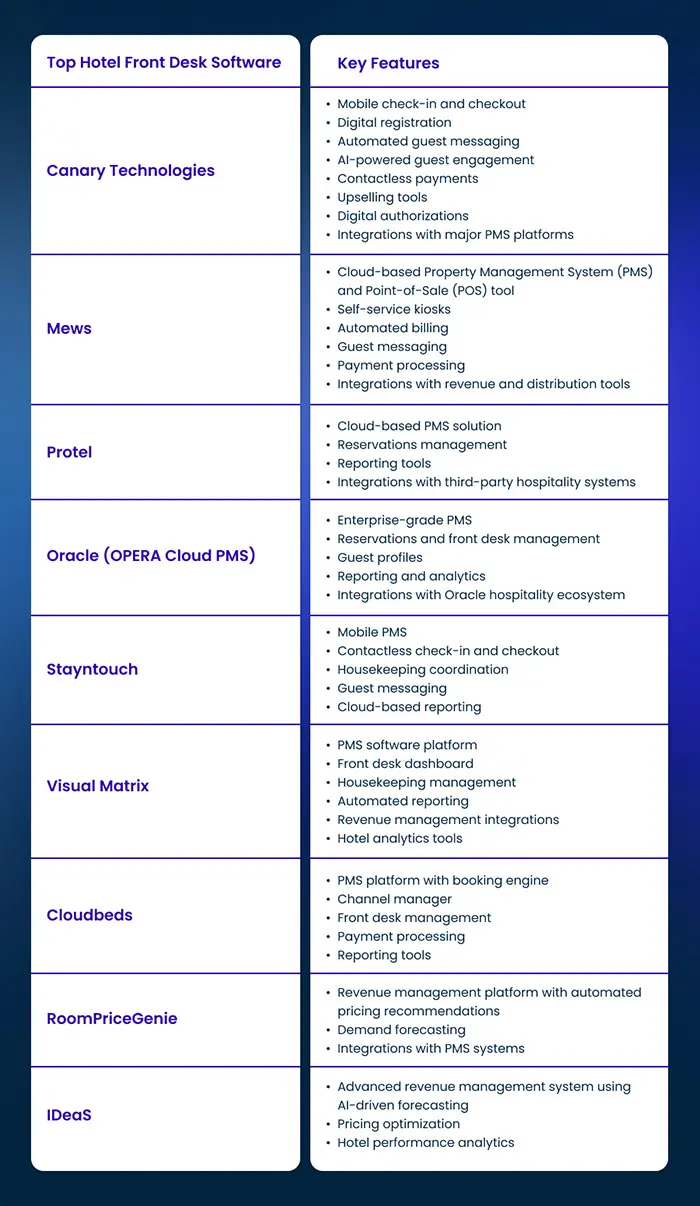
If you want your hotel to run smoothly and efficiently, finding the best B2B front desk software in the hospitality industry is key. Here are some of the top hotel front desk software platforms hospitality businesses are using in 202
Top Hotel Front Desk Software
Key features
Canary Technologies
Mobile check-in and checkout
Digital registration
Automated guest messaging
AI-powered guest engagement
Contactless payments
Upselling tools
Digital authorizations
Integrations with major PMS platforms
Mews
Cloud-based Property Management System (PMS) and Point-of-Sale (POS) tool
Self-service kiosks
Automated billing
Guest messaging
Payment processing
Integrations with revenue and distribution tools
Protel
Cloud-based PMS solution
Reservations management
Reporting tools
Integrations with third-party hospitality systems
Oracle (OPERA Cloud PMS)
Enterprise-grade PMS
Reservations and front desk management
Guest profiles
Reporting and analytics
Integrations with Oracle hospitality ecosystem
Stayntouch
Mobile PMS
Contactless check-in and checkout
Housekeeping coordination
Guest messaging
Cloud-based reporting
Visual Matrix
PMS software platform
Front desk dashboard
Housekeeping management
Automated reporting
Revenue management integrations
Hotel analytics tools
Cloudbeds
PMS platform with booking engine
Channel manager
Front desk management
Payment processing
Reporting tools
RoomPriceGenie
Revenue management platform with automated pricing recommendations
Demand forecasting
Integrations with PMS systems
IDeaS
Advanced revenue management system using AI-driven forecasting
Pricing optimization
Hotel performance analytics
What Is Hotel Front Desk Software?
Hotel front desk software is a digital platform or integrated suite of tools that manages the daily operations of a hotel’s reception desk, such as check-ins, payments and guest communication. It allows front desk staff to perform key operational tasks from a single location.
It all starts with your Property Management System (PMS), an essential digital foundation for any hotel. On it, bespoke layers of software, such as guest and revenue management solutions, are stacked. This versatile system has become the norm for its adaptability and cloud-based nature. And the impact of this integrated approach is significant: According to Hotel Tech Report, 89% of hotels save between two and 10+ hours per week thanks to cloud-enabled front desk software.
With the right tech stack, hotels connect guest data, reservations and operational tasks. They’ve said “goodbye” to juggling paperwork and clicking between disconnected tools. Now it’s “hello” to automated front desk systems, faster service, fewer errors and smoother front desk operations.
Here are some of the processes hotel front desk software supports:
Reservation and check-in management: Access bookings, assign rooms and process check-ins or checkouts.
Guest communication: Send updates and respond to guest requests through integrated messaging tools.
Payment processing: Securely manage deposits, payments and digital authorizations to reduce fraud and chargebacks.
Operational coordination: Sync with housekeeping and other departments to track room status, service tickets and guest needs.
Reporting and analytics: Monitor key performance indicators (KPIs), guest activity and revenue insights through built-in reporting tools.
What Are the Leading Front Desk Tech Solutions for Hotels?
The ideal front desk operation depends on your service model, facility complexity and room count. It all revolves around your needs. If you want to enhance the guest experience, there are Guest Management Systems, and to increase revenue, there are Revenue Management Systems. AI capabilities are also often incorporated.
The following platforms represent the best B2B front desk software in the hospitality industry today.
1. Canary Technologies
Canary Technologies is a modern platform for hotel guest management that powers the entire digital guest journey from booking through checkout. Hotels use Canary to manage arrivals, communication, payments, upsells and guest engagement, creating a consistent and scalable experience.
By becoming an invisible partner to hotel staff, the platform reduces front-desk workload while improving service speed and guest satisfaction. Review scores can increase by over a point as a result, like at Ali’i Resorts. The platform empowers on-site staff to excel at the human aspects of hospitality.
Key features of Canary:
Mobile Check-In and Smart Checkout for smooth arrivals and departures
Guest Messaging for better guest communication
Digital Authorizations for secure payments
Dynamic Upsells to drive additional revenue
AI-powered guest engagement
Tablet Registration for digital registration cards
Integrations with major PMS platforms
2. Mews
Mews is a cloud-based PMS and hospitality POS designed to modernize hotel operations by making them more guest-centric. It replaces traditional front desk workflows with automated tools that streamline reservations, billing and guest services. The platform is used across brands, boutique hotels and hostels looking for flexible, cloud-native hotel management software.
Key features of Mews:
Cloud-based PMS
Self-service kiosks and digital check-in
Automated billing and payments
Guest profiles and reservation management
Integrations with other hospitality technology platforms through one of the largest marketplaces in the industry
3. Protel
Protel is a hotel PMS within the Planet Hospitality Suite. It supports front desk operations, reservations and guest services through a cloud- or server-based solution. It is frequently used by hotels and hospitality groups that manage multiple properties. The system integrates with hospitality technology partners to create a connected and comprehensive ecosystem.
Key features of Protel:
Reservation and front desk management
Centralized guest profiles
Reporting and analytics tools
Multi-property support
Integrations with other hospitality technology systems through a marketplace
4. Oracle Opera
Oracle Opera is one of the most widely used enterprise property management systems in the hospitality industry. Large hotel brands and global chains rely on Opera to manage reservations and guest data at a PMS level in ways that align with their Central Reservation System (CRS) setup. The platform offers customization, integrations and analytics for hotel operations of varying complexity through its Lite, Standard and Premium offerings.
Key features of Oracle Opera:
Enterprise-grade PMS
Reservation and front desk management
Guest profile and loyalty program management
Advanced reporting and analytics
Integrations across Oracle’s hospitality ecosystem
5. Stayntouch
With a tablet-first user interface, Stayntouch provides a cloud-based hotel management platform that decouples front-desk workflows from desktops. It allows hotel staff to manage check-ins, room assignments and guest requests from tablets or mobile devices. This makes it a popular solution for hotels seeking operational flexibility.
Key features of Stayntouch:
Mobile PMS
Contactless check-in and checkout
Housekeeping and room status management
Guest communication tools
Real-time reporting and analytics
6. Visual Matrix
Visual Matrix offers a PMS designed to strengthen hotel operational visibility across departments. The platform combines front desk tools, housekeeping management and reporting to give hotel teams a clear view of daily operations. Its customer base includes independent hotels and regional hospitality groups.
Key features of Visual Matrix:
Front desk and reservations management
Housekeeping coordination tools
Automated reporting dashboards
Revenue management integrations
Operational analytics
7. Cloudbeds
Cloudbeds is a hospitality management platform that combines the PMS with distribution functions through its channel management and booking tools into one system. Hotels use Cloudbeds to manage reservations, front desk operations and distribution across multiple booking channels. This makes it a popular all-in-one solution for independent hospitality brands.
Key features of Cloudbeds:
Cloud-based PMS
Integrated booking engine
Channel manager for OTA distribution
Front desk and reservations management
Reporting and performance analytics
8. RoomPriceGenie
RoomPriceGenie is a revenue management system (RMS) that automates hotel pricing decisions. It analyzes market demand, booking trends and competitor pricing to recommend optimal room rates and is popular with independent hotels that may not have an on-site revenue manager. While not a front-desk system itself, it integrates with PMS platforms to support revenue optimization in hotel operations.
Key features of RoomPriceGenie:
Automated pricing recommendations
Demand forecasting tools
Competitor price monitoring
Revenue performance dashboards
Integrations with hotel PMS platforms
9. IDeaS
IDeaS provides advanced revenue management technology for hotels. Its AI-driven forecasting and pricing optimization tools allow hotels to maximize revenue while maintaining competitive rates, supporting revenue managers across major chains. The platform integrates with a variety of PMS solutions to support broader hotel operations.
Key features of IDeaS:
AI-powered revenue management
Demand forecasting and analytics
Automated pricing optimization
Market data insights
PMS integrations for operational alignment
What Are the Key Features to Look for in Front Desk Software?
From the list above, you can see that not all hotel technology platforms offer the same capabilities. Some include a PMS, while others provide the functionality to build specializations around existing systems. Each technology is a building block, so hotels can build a tech stack that serves their brand.
The most effective solution for your property should provide tools that streamline your specific operations across the full guest journey, whatever that looks like for your hotel. Do you need to connect on-site spend from multiple F&B venues, spa or shops to your guest folios? A POS integration is needed. Would you like to strike up a conversation with guests by text in advance of their stay and offer personalization? You need guest messaging software for scale and potentially an AI-enabled provider to support the team.
To help you assess your hotel's needs, below are some of the most important features to consider when assembling the building blocks of modern front desk software.
Reservation and Booking Management
The core of any front desk operation is a strong reservation engine. The job is clear: Rather than using paper to match bookings to available dates and rooms, reservation systems manage and organize bookings, prevent overbooking and offer clear visibility into upcoming arrivals and departures.
Driven by the development of APIs and cloud computing, today’s room reservation systems connect reservations from multiple channels — including direct bookings, OTAs and travel agents via the GDS — and share accurate, real-time information with other systems, such as an RMS. It serves as the primary hub for most other technology layers. Reservation management capabilities to look for include:
Centralized reservation dashboard
Real-time availability updates across booking channels
Group booking and reservation management
Automated booking confirmations and updates
Integration capabilities with other tech layers
Enhanced Check-In and Check-Out Processing
The front desk (where your team has access to the PMS) isn't the only place where guests can enjoy speedy check-in and checkout anymore. Given the choice, almost half of guests prefer to check out on their phone, according to the 2025 Guest Technology report.
To reduce front-desk congestion and improve the guest experience with a speedy arrival and departure process, use mobile tools that maintain secure payment verification. Contactless check-in technology allows guests to complete registration, verify payment details and receive key instructions before they arrive, allowing hotel staff to focus on service instead of paperwork.
Look out for important features such as:
Mobile or contactless check-in workflows
Digital registration cards
Automated checkout and folio delivery
Secure payment authorization and processing
Integration with mobile keys and door lock systems through NFC and Bluetooth
Real-Time Room Status and Assignment
Coordinating the front desk with the back of the house used to be a manual game of telephone. Staff relied on internal phone calls, walkie-talkies or even physical lists to report which guests had departed and which rooms were ready to be occupied. While this approach may still work for small operations, it’s now easy for housekeeping to use mobile technology alongside the PMS.
Real-time room status updates allow staff to quickly assign rooms and prevent delays during peak arrival periods, while other modern capabilities can advance tasks such as picking up trays in hallways through IoT sensors. AI is impacting scheduling in this space, with one hotel reporting a 20% increase in room-cleaning speed in a joint BCG and NYU analysis.
Real-time room features to look for include:
Live room status updates from housekeeping
Automated room assignment and scheduling tools
Intuitive user interface
Maintenance status tracking
Customizable staff task sheets
Guest Profiles and Preference Tracking
Personalization in most PMS and CRM systems has been plagued by inconsistencies in how guest preferences are entered and used.
To deliver personalized service, hotels now rely on technology to automate profiles and document their guests’ preferences to better support their concierge’s impressive memories. Integrated AI guest messaging tools further enhance this capability by automating communication and responding to guest requests quickly throughout the stay.
To enhance personalization and guest preference tracking, look for these key features:
Automated guest profiles and stay history
Preference tracking for amenities and room types
Automated guest messaging and request handling through ticket creation
Communication logs across departments
Personalization tools for returning guests
Integrations and Scalability
Any layer of your front desk platforms needs to be integrated with your PMS — and depending on your setup, they may also need to integrate with payment providers, revenue management tools and other hospitality technology. A scalable system is one that can support your operations without requiring major system changes, which is why integrations are so important.
Capabilities you should ask for include:
Integrations with PMS, CRM and payment systems
Connectivity with revenue management tools
Open APIs for third-party integrations
Multi-property management capabilities
Cloud-based architecture for scalability
Selecting the Best Front Desk Management Platform for B2B Hospitality
As you can see, a Front Desk Management Platform is like creating a sandwich: it's not just about one app, but about layering the right ingredients.
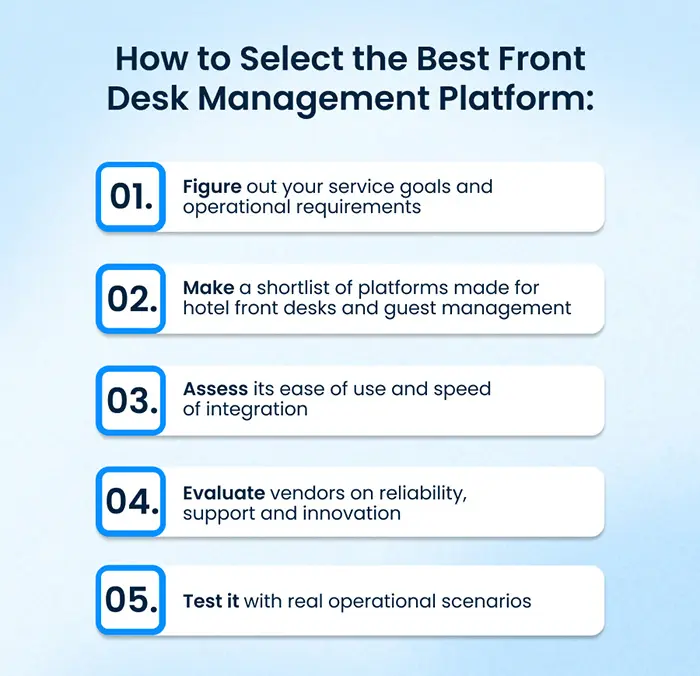
The best platform is actually a custom ecosystem. It starts with a rock-solid PMS foundation, may layer on a Guest Management Suite for that human touch, and top it off with a Revenue Management System to keep the math in your favor. Choosing the right tech requires a strategy for how these layers talk to each other to support your staff and elevate the guest experience. The following framework will help you design the best B2B front desk software in the hospitality industry.
1. Identify Your Operational Requirements and Service Goals
Start by clearly defining what you want your front desk technology to achieve. Every hotel has different operational priorities, from reducing check-in times to improving communication with guests or driving more upsell revenue.
Mapping out your current front desk workflows helps reveal inefficiencies and identify the areas where technology will have the biggest impact. Hotels should consider:
Current operational pain points at the front desk
Guest experience goals for arrivals, in-stay communication and departures
Opportunities to reduce manual processes and paperwork
Revenue generation via upselling and digital payments
Staffing challenges and labor efficiency needs
2. Shortlist Platforms Built for Hotel Front Desk and Guest Management
Not all software available in the hospitality industry is designed specifically for hotel front desk operations. A great restaurant management tool, for example, likely won’t work well for a hotel tech stack where all information must flow back to the front desk.
When shortlisting vendors, prioritize platforms designed for hotels, guest engagement and front desk workflows. The technology should support arrivals, communication and checkout processes. Key considerations include:
Platforms purpose-built for hotel operations
Tools that manage the full guest journey, not just reservations
Mobile-first experiences for both staff and guests
Automation for check-in, payments and guest communication
Guest engagement features that improve service quality
3. Evaluate Usability Across Your Hotel Tech Stack
Here’s a red flag: If your team needs to export and import reports regularly to move data between tools, you’re buying a headache, not a high-speed workflow. On the flip side, a system is suitable for your hotel if it is well-integrated and easy for staff to use. Front desk technology must be intuitive and accessible so teams can adopt it quickly without extensive training. Only then can they keep their focus on guests.
Evaluate how any new platform integrates with existing technology to ensure smooth data sharing between systems. Important evaluation criteria include:
User-friendly dashboards for front desk teams
Mobile accessibility for staff anywhere on or off-site
Integrations with existing technology
Minimal training required for onboarding staff
Reliable performance in comparable hotel operations or with portfolios of your size
4. Review Vendor Reliability for Long-Term Growth
Your software provider is your next long-term partnership. Evaluate vendors not only on product capabilities but also on reliability, support and innovation. Look for online reviews and case studies that showcase continuous investment in product improvement and strong customer support.
A reliable technology partner will have ample evidence that you are about to make a good long-term investment and won't need to switch vendors anytime soon. Hoteliers should review:
Vendor reputation within the hospitality industry
Customer support availability and response times
Product roadmap and ongoing innovation
Security and compliance standards for guest data
Case studies and customer success stories
5. Validate Performance and ROI Through Real Operational Scenarios
The final test for any layer in your stack is simple: does it actually move the needle on your bottom line? The best front desk technology components reduce manual work, speed up service and improve guest satisfaction.
The numbers don’t lie. Testing any platform through demos or pilot programs provides insight into how it performs in your hotel environment. Depending on the tool and your goals, look for evidence such as:
Reduced front desk check-in times
Higher guest satisfaction scores
Increased upsell revenue or ancillary sales
Reduced payment fraud and chargebacks
Improved staff productivity and operational efficiency
Enhance Guest Experience with Hotel Front Desk Software from Canary
The most effective hotel front desk software provides a perfect trifecta of foundation, intelligence and service that streamlines the entire guest journey. Canary delivers a complete solution for hotel guest engagement that modernizes front-desk workflows and elevates the experience for both staff and guests. The days of juggling disconnected tools are over. Hotels can now manage arrivals, communication, payments and upsells through a single platform.
With solutions like Canary’s Mobile Check-In, Guest Messaging, Dynamic Upsells and Omnichannel AI, your front desk team spends less time on administrative work and more time delivering memorable guest experiences. Hotels that implement Canary see meaningful improvements across operations and service delivery.
Key outcomes hotels achieve with Canary include:
Faster check-ins with mobile registration and digital arrivals
Reduced front desk workload through automated guest workflows
Higher revenue through Dynamic Upsells and digital guest engagement
Faster response times with AI-powered Guest Messaging
Stronger payment security with Digital Authorizations
Improved guest satisfaction through seamless digital experiences
Greater operational efficiency across arrivals, in-stay service and departures
Book a demo today and see why Canary is the best front desk management platform for B2B hospitality.
Frequently Asked Questions
What's the best front desk software for hotels?
The best B2B front desk software in the hospitality industry is the one that fits your hotel. That means it depends on your operational goals, property size and existing technology stack. Leading solutions typically offer features like mobile check-in, guest messaging, payment processing and integrations with PMS foundations.
Platforms like Canary stand out because they go beyond traditional front desk tools. Its Guest Management Platform digitizes the full guest journey, from arrival to checkout, improving both operational efficiency and the guest experience.
How do modern front desk systems work?
Modern hotel front desk systems are composed of technology layers that, through clever integrations, can serve as a unified platform. Staff can manage reservations, assign rooms, process payments and communicate with guests from one place.
These systems automate manual tasks and provide real-time operational data, allowing hotel teams to serve guests faster while reducing administrative workload.
How does AI boost front desk operations in hotels?
Artificial intelligence is rapidly being woven into hotel technology and operations. Through hospitality AI, hotels automate routine guest communication, analyze operational data and provide faster service across the guest journey.
AI-powered tools can respond to common guest questions, automate messaging, recommend upsell opportunities and provide insights that help hotel teams operate more efficiently. As a result, front desk staff spend less time handling repetitive requests and more time delivering personalized guest experiences.