Chargebacks. They’re a frustrating reality for hotels, and now, a growing operational and financial risk. In fact, the sheer volume of chargebacks is projected to grow 24% by 2028 globally. With guests booking through OTAs, digital wallets and mobile apps, payments happen long before arrival and well after checkout. That shift makes it incredibly easy for a simple misunderstanding over a deposit or an incidental fee to turn into a formal dispute.
Keeping that money in the bank isn't a job just for the accounting team. Implementing the best practices for hotels to avoid chargebacks requires your front desk, operations and management teams to actually work from the same playbook. When you get everyone on the same page (communicating clearly at booking, handling authorizations the right way and giving guests an accurate folio at checkout), you shut down disputes before they even happen.
Key highlights:
A hotel chargeback occurs when a guest disputes a charge and the bank reverses the payment. Hotels need to prove the charge was valid, or lose the revenue and pay extra fees.
Chargebacks are increasingly driven by card-not-present bookings, unclear policies and gaps in identity or payment verification during the guest journey.
Preventing disputes requires coordinated processes across reservations, check-in, payment authorization and post-stay communication.
Canary helps hotels reduce disputes through secure digital authorizations, verified guest workflows and centralized payment documentation within a modern guest management platform.
What Is a Hotel Chargeback?
A hotel chargeback occurs when a guest disputes a payment with their credit card issuer or bank, prompting the financial institution to reverse the transaction while it investigates the claim. This is first-party fraud (often called “friendly fraud”) and accounts for roughly 75% of all chargebacks, according to wisernotify.com.
Instead of calling your front desk to work out an issue, the guest goes straight to their bank. The bank immediately pulls the money from your account, usually over a surprise incidental fee, a disputed no-show charge or a stolen card.
In these cases, the bank is entirely in charge. They take the funds, hit you with extra penalty fees and force your team to dig up paperwork to prove the charge was legitimate. It’s an expensive, one-sided process that can drag on for months. Chargeflow.io reports that for every $1 lost to a chargeback, hospitality merchants incur $450 per dispute.
Learn more about how disputes impact hospitality operations in our guide to hotel chargebacks.
A Normal Refund
A Chargeback
Who is in control?
You (The Hotel)
The Bank
How does it start?
You speak with the guest and agree to return their money.
The guest complains to the bank, and the bank yanks the funds.
Are there penalties?
No extra fees.
Yes, the bank hits you with extra penalty fees.
What's the workload?
Quick and resolved internally.
You must dig up paperwork to prove the charge was legitimate.
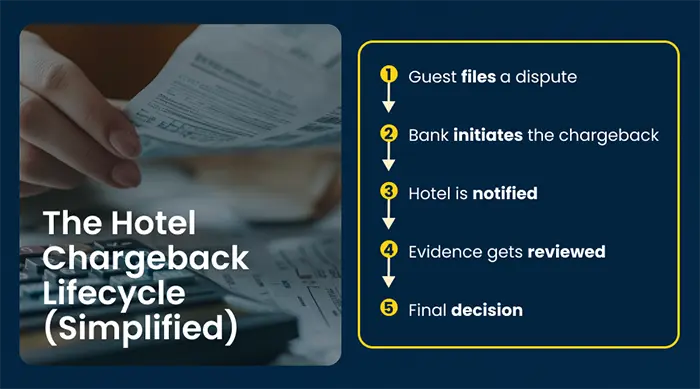
The Hotel Chargeback Lifecycle (Simplified)
While the process can sound technical, the hotel chargeback lifecycle follows a fairly predictable path:
Guest files a dispute: The cardholder contacts their issuing bank after noticing or questioning a charge.
Bank reviews and initiates the chargeback: If the claim meets card network rules, the bank reverses the transaction and sends the dispute through payment networks to the hotel’s acquiring bank.
Hotel receives notification: The hotel is asked to either accept the loss or submit evidence proving the charge was valid.
Evidence review (representation): Documentation such as signed registration cards, folios, ID verification or cancellation policies may be reviewed.
Final decision: The issuing bank determines whether the guest keeps the refund or the funds are returned to the hotel.
Because multiple financial institutions participate in this process, disputes can remain open for extended periods, tying up revenue and creating operational overhead for hotel teams. Understanding how chargebacks work is the first step toward building prevention strategies across reservations, front desk operations and payment workflows.
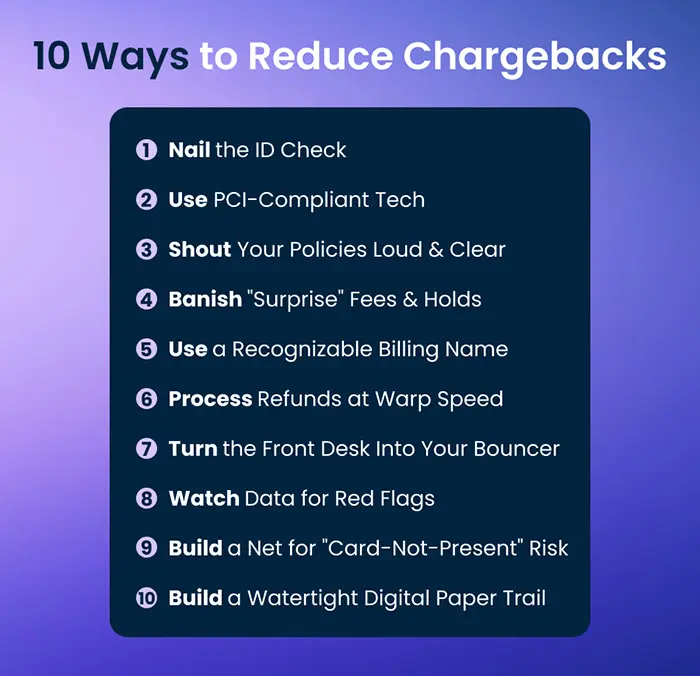
How to Reduce Chargebacks in Hotels: 10 Best Practices
Preventing disputes means being proactive, rather than just reacting to claims. To do this effectively hotels can eliminate confusion, strengthen their payment verification and create clear documentation throughout the guest journey.
When hotels treat chargeback prevention as part of daily operations rather than a back-office task, they significantly lower risk while improving transparency for guests. The following steps help you proactively reduce fraud chargebacks before they reach banks or card networks.
Step
Strategy
Key Action Items
1
Nail the ID Check
• Require Government ID: At the desk or via secure mobile check-in.
• Match Names: Make sure the ID matches the credit card.
• Verify Businesses: Confirm third-party or corporate bookings first.
• Flag Weird Behavior: Mismatched names or strange habits are red flags.
2
Lock Down Payment Tech (PCI-Compliance)
• Use Tokenization: Never store raw card numbers.
• Go Digital: Ditch paper authorization forms for secure links.
• Encrypt Everything: Whether on a phone or at the front desk.
• Track Access: Know who processed what, and limit sensitive data access.
3
Shout Your Policies Loud & Clear
• Front & Center: Put cancellation deadlines on the booking page.
• Force Agreement: Use an "I agree" checkbox before confirmation.
• Be Consistent: Match policies on booking, emails, check-in and OTAs.
4
Banish "Surprise" Fees & Holds
• Explain Holds: Tell guests about incidental holds before charging.
• Get Written Consent: For resort fees, parking and incidentals.
• Show Estimates: Provide a digital summary of charges during the stay.
5
Use a Recognizable Billing Name
• Property Name First: Make sure it’s clear which hotel the charge is from.
• Keep it Consistent: Use the brand name guests recognize most.
• Add a Number: Include your front desk phone number on the descriptor.
6
Process Refunds at Warp Speed
• Set a Deadline: Give managers 24 hours to approve legitimate refunds.
• Automate: Return funds directly to your PMS when policies allow.
• Communicate: Tell the guest exactly when the money will hit their account.
7
Turn the Front Desk Into Your Bouncer
• Spot the Scams: Train staff to inspect IDs and verify matching cards.
• Explain the Fine Print: Teach them to communicate policies, not just read them.
• Enforce Rules: Give them confidence to say "no" to suspicious transactions.
8
Watch Data for Red Flags
• Spot Anomalies: One card booking five rooms under different names.
• High-Value, Last-Minute: A suite booked at 11:30 PM for the same night.
• Multiple Declines: A card that finally goes through on attempt four.
9
Build a Net for "Card-Not-Present" Risk
• Force Digital Check-In: Require secure registration before arrival.
• Use 2FA: Turn on two-factor authentication for online gateways.
• Stop Manual Entry: Forbid staff from typing card numbers by hand.
10
Build a Watertight Digital Paper Trail
• Digital Signatures: Get reg cards and payment agreements signed on-screen.
• Time-Stamps: Track the exact second they accepted policies and fees.
• Cloud Storage: Keep all authorization records attached directly to the folio.
• Easy Access: Be able to pull evidence in 3 clicks or less.
1. Verify Guest Identity Before Charging Cards
A guest claiming "I never stayed there" or using a stolen credit card is a classic fraud tactic, but it’s possible to stop it before they even check in. An airtight ID check process is the first line of defense against scammers (who are getting smarter all the time).
Strong identity controls are especially important as hotel industry fraud continues to evolve within digital booking channels and remote check-in processes. To strengthen identity verification:
Check the ID: Require government-issued ID verification at check-in or during digital registration
Match the names: Match guest identification with the payment method on file whenever possible
Double-check the businesses: Verify third-party or corporate bookings before charging cards
Use secure check-in tech: Use secure digital check-in technology that captures verified guest details
Watch for weird behavior: Train your team to flag mismatched names or strange booking habits immediately.
2. Use Secure, PCI-Compliant Payment and Authorization Tools
Writing card numbers on sticky notes or keeping them in an unlocked filing cabinet is a chargeback waiting to happen. Get tech that actually protects data and gives you an ironclad audit trail in case the bank has questions.
Adopting tools aligned with PCI compliance standards ensures sensitive cardholder data is protected while creating audit-ready payment records that hotels can rely on during disputes.
Your Must-Haves for Payment Tech:
Tokenized payments so you never actually store raw card numbers.
Secure digital links
Encrypted payments
Automated audit trails tied to each transaction
Restricted staff access to sensitive payment information
3. Make Cancellation, Refund and No-Show Policies Explicit
A lot of chargebacks are simply the result of guests who didn't read the fine print. If your cancellation deadlines or no-show fees are hidden in a wall of text, you’ll likely lose any dispute. Make it impossible for them to say, "I didn't know."
How to make it stick? Put the deadline front and center on the booking page, and add a required "I agree" check box before the reservation goes through. Keep those exact same rules in the confirmation email, remind them again at check-in and make sure your website matches what you tell the OTAs.
4. Set Clear Expectations Around Fees and Incidentals
Nobody likes surprise charges on their bank statements. If a guest doesn't expect a $100 incidental hold or a $25 daily resort fee, their first reaction is to call their bank. Using tools like digital contracts allows hotels to clearly document acceptance of incidental charges and property policies before a transaction occurs. Reduce confusion by:
Explaining incidental holds before arrival and at check-in
Providing written acknowledgment of additional fees
Showing estimated authorization amounts during registration
Offering digital summaries of charges during the stay
Communicating how and when holds are released
5. Use Recognizable Billing Descriptors
If a guest reviews their Amex statement a month after their trip to "The Grand Plaza" and sees a charge from "LLC Holding Co. 482," you can be certain they’ll hit the dispute button immediately. Your billing name needs to be instantly recognizable.
Use your actual property name across every property in your portfolio, and if you can, add your front desk phone number right onto the billing descriptor. Test it yourself to see what actually comes up on a bank statement.
6. Process Refunds Quickly and Consistently
If you promise a guest a refund but take three weeks to process it, they’ll likely lose patience and call their bank. A slow refund easily turns into an expensive, messy chargeback. Move fast and keep the guest in the loop. Stick to these rules:
Set a hard deadline for managers to approve refunds (e.g., within 24 hours).
Automate the return in your PMS if it fits your standard policy.
Tell the guest exactly when the money will hit their account.
Make sure the front desk and the finance team are in sync so nothing falls through the cracks.
7. Train Staff on Payment and Fraud Prevention Procedures
Front desk and reservations teams are often the first line of defense against disputes. Without consistent procedures, staff may accidentally skip verification steps or fail to properly explain policies, leading to disputes down the line.
Ongoing hotel staff training ensures employees understand both fraud risks and the documentation required to defend transactions.
What your team needs to know:
How to properly inspect an ID and verify the matching card.
How to explain the fine print without sounding like a robot.
How to handle the classic "my company is paying for this" routine safely.
Who to call when a booking feels off.
8. Monitor Transactions for High-Risk Patterns
Catching a fraudster before they walk through the doors is much cheaper than fighting the chargeback once they leave. Pay attention to your booking trends. If you watch the data, the scams usually stick out like a sore thumb.
Modern payment tools and digital authorizations make it easier to identify anomalies tied to disputes or fraud attempts. Monitor for:
Multiple bookings using the same card across different names
Last-minute, high-value reservations
Repeated declined authorization attempts
Bookings originating from high-risk regions or proxies
Unusual spending behavior during stay
9. Reduce Card-Not-Present Transaction Risk
Swiping a physical, chip-enabled card is safe. Typing numbers from a phone call or pulling them from a web portal is risky. As more guests check in from their phones and pay online, you need a stronger net to catch bad actors.
Here are hoops that’ll catch potential fraud:
Secure digital check-in
Two-factor authentication for online payments
Email and phone number verification
Limit manual entering of credit card numbers
10. Document Guest Consent and Authorizations Digitally
When a dispute happens, the bank doesn't care what you say — they care what you can prove. A messy paper registration card with a scribbled signature won't win a chargeback. You need a digital paper trail that proves without a doubt that the guest agreed to pay.
Digital documentation systems and secure credit card authorization forms provide time-stamped proof that guests have agreed to the charges and policies. Hotels should implement:
Digital Signatures: Have them sign the reg card and payment agreements on a screen or their phone.
Time-Stamps: Track the exact second they accepted your cancellation and fee policies.
Cloud Storage: Keep all authorization records securely saved and attached directly to the guest's folio.
Easy Access: Make sure your managers can pull this exact evidence in three clicks or less when the bank sends a dispute notice.
Reduce Hotel Chargebacks with Canary
Chargebacks fizzle out when your systems are digitally connected and secured. Scammers like to take advantage of a busy front desk — if you’re relying on manual credit card entries, messy paperwork or spotty communication, they’ll find out.
This is where Canary does the heavy lifting. Instead of forcing your team to juggle a dozen apps or paper forms, Canary locks down your payment authorizations, ID checks and signed policies in one secure platform. It builds a watertight digital paper trail in the background without slowing down the guest's arrival. If a bank ever comes knocking with a dispute, you already have the exact proof you need to win it.
Key ways Canary helps reduce hotel chargebacks include:
Verified digital check-in workflows that confirm guest identity before payment processing
PCI-compliant payment collection and encrypted data handling
Time-stamped guest agreements and policy acknowledgments are stored automatically
Centralized documentation is accessible for faster dispute responses
Automated communication that clearly outlines fees, policies and stay details
Integrated audit trails connecting payments, guest profiles and folios
Book a demo today and see how comprehensive solutions from Canary help reduce hotel chargebacks and protect your bottom line.
Frequently Asked Questions
Can hotels fight chargebacks successfully?
Yes, hotels can successfully fight chargebacks when they have clear documentation proving that the guest authorized the transaction and received the agreed-upon services. Many disputes are resolved in favor of the merchant when evidence shows policies were disclosed, identity verification occurred and payment authorization was properly obtained. However, success depends heavily on how well operational processes capture and store this information during the guest journey.
Hotels are far more likely to win disputes when prevention and documentation are built into daily workflows rather than assembled after the fact. Strong cases typically rely on consistent records collected at booking, check-in and checkout, including signed agreements and communication history with the guest.
What documentation is needed to win a hotel chargeback?
Winning a chargeback requires evidence that directly links the guest to the reservation, payment method and stay experience. Banks review whether the hotel can demonstrate authorization, acceptance of policies and fulfillment of promised services.
Common supporting documentation includes:
Signed or digitally accepted registration agreements
Credit card authorization records or payment confirmations
Communication records such as emails or messages with the guest
Maintaining centralized, time-stamped records significantly improves response speed and strengthens a hotel’s position during dispute reviews.
How long does a hotel have to respond to a chargeback?
Response timelines vary by card network and acquiring bank, but hotels typically have 7-30 days to submit evidence after receiving a chargeback notification. Missing this deadline usually results in an automatic loss of the dispute, regardless of whether the charge was legitimate.
Because timelines are short and documentation requirements are strict, hotels benefit from having organized payment and guest records readily available. Automated systems that store authorizations, agreements and transaction histories help teams respond quickly without scrambling across multiple departments or systems.