Online reviews hold power. They influence where travelers book, how much they’re willing to pay and whether they trust your property in the first place. Yet many hotels still treat reviews as a customer service task instead of a revenue strategy. Hotel review management is a mindset shift: instead of viewing review monitoring as “damage control,” see it as a “growth engine.”
Better exposure on booking channels, higher rates and long-term guest trust can all be yours with some deliberate digital reputation curation. In this guide, you’ll learn the practical steps to turn every guest voice into a reliable lever for your property’s growth.
Key highlights:
Hotel review management is the structured process of monitoring, generating and responding to guest reviews across platforms to influence booking decisions, increase visibility and build guest trust.
Strong review performance directly impacts revenue by improving Online Travel Agency (OTA) rankings, strengthening social proof and increasing conversion rates on booking pages.
The most successful hotels treat reviews as an operational system and have clear processes for requesting feedback and responding consistently.
Platforms like Canary’s Guest Management System automate post-stay communication and guest messaging, making it easier to collect more reviews and improve guest sentiment at scale.
What Is Review Management for Hotels?
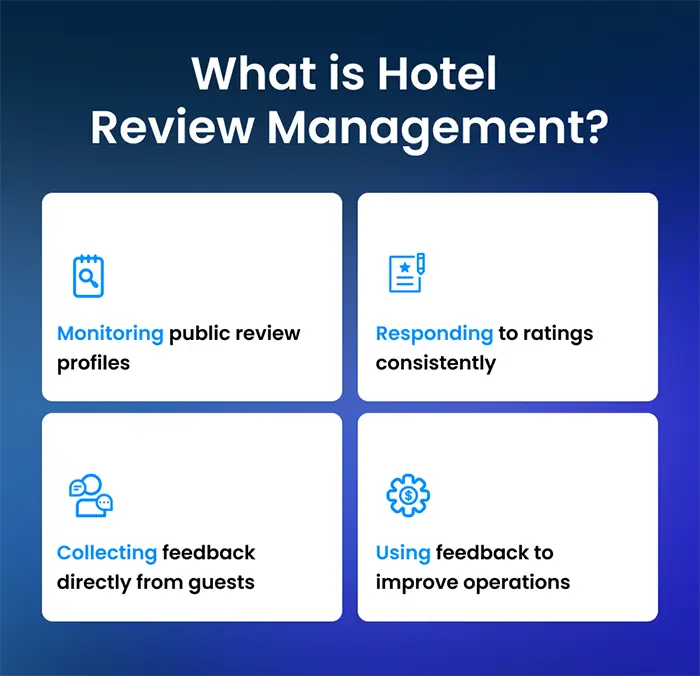
Hotel review management is the continuous process of monitoring, responding to and acting on guest feedback across any review platforms. It’s based on the premise that through structured online review management practices, you can transform guest feedback into actions that improve service levels, strengthen reputation and influence booking decisions.
In fact, a 2012 Cornell study found that if a hotel increases its review scores by 1 point on a 5-point scale, it can increase its price by 11.2 percent while maintaining the same occupancy or market share. Additionally, increasing review scores by 1 has a positive impact on Average Daily Rate (ADR), occupancy and Revenue Per Available Room (RevPAR). With the case for managing online reputation more apparent by the day, key practices have evolved. Today, a strong hotel review management strategy typically includes:
Monitoring public reviews across OTAs and travel platforms where guests evaluate your reputation before booking
Collecting private guest feedback through post-stay surveys, in-stay messaging and digital feedback tools
Responding consistently to both positive and negative reviews to demonstrate attentiveness and professionalism
Acting on feedback operationally by identifying patterns and improving service, amenities or processes
Key Hotel Online Review Management Strategies
“Occasional response” and “last-minute damage control” are the kinds of reactive default behaviors hotels must overcome to develop a strategy that both generates and manages reviews. The most successful hotels use repeatable processes to consistently elicit positive feedback and handle guest sentiment professionally.
When you standardize responses, create moments that inspire good feedback and use the right tools to streamline the process, reviews become a predictable driver of trust, visibility and bookings. The strategies below focus on delivering this operational consistency:
1. Standardize the Response to Hotel Reviews
Responding to hotel reviews is one of the most visible parts of reputation management. Future guests are always watching! While consistency and speed are important, responding to every review (especially if it’s with a copy-and-paste “appreciation” message) can be detrimental.
Thoughtful review responses are:
Consistent:
Create internal response guidelines so the right reviews, such as concerns or specific praise, receive a thoughtful reply
Ensure responses follow a similar structure and tone across platforms
Quick:
Aim to respond within 24–48 hours
Prompt responses show attentiveness and reassure prospective guests
Keep the tone warm, professional and guest-focused
Personalized:
Reference specific details from the guest’s stay
Avoid copy-paste responses that feel generic or automated
Professional:
Thank guests for feedback, even when the review is critical
Focus on resolution and improvement rather than defensiveness
2. Drive Positive Reviews Through Consistent Service
The most effective way to get good reviews is simple: deliver consistently strong guest experiences. Many highly-rated tourist spots and restaurants have done this by regularly offering what made them viral in the first place (access to stunning views, immaculate service or picture-worthy meals, like a melted chocolate dome over ice cream). When expectations are clear and service is reliable, satisfied guests naturally share positive feedback online.
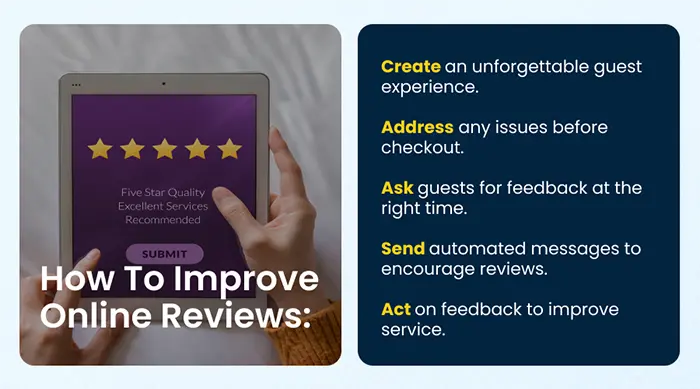
To generate a high volume of positive reviews, treat review generation as part of the guest journey. By engaging guests during their stay and requesting feedback at the right moment, you increase the likelihood that happy guests will leave positive reviews and let any issues be resolved privately. Hotels should:
Set Expectations Early:
Clearly communicate amenities, policies and service standards through branding and relevant pre-arrival messaging
Accurate expectations reduce the likelihood of negative reviews
Engage Guests During the Stay:
Use in-stay communication to check in with guests in person or through text, for example shortly after arriving in their room or when leaving a restaurant
Early engagement allows staff to resolve issues before checkout
Collect Private Feedback First:
Encourage guests to share concerns during the checkout process, before they find themselves posting online
Direct feedback helps teams resolve problems quickly
Ask at the Right Moment:
Send review requests shortly after checkout when the experience is fresh
Timing significantly increases response rates
Remove friction:
Use direct links to review platforms in post-stay communications
Making it easy for guests to leave reviews significantly improves guest engagement
3. Use Software to Streamline Review Management
At a time when there are multiple Online Travel Agencies (OTAs), travel sites and search platforms, tracking reviews manually quickly becomes overwhelming. Hotel review management software simplifies this process by centralizing feedback and automating parts of the workflow.
With the right technology in place, you have visibility across platforms, can respond faster and generate more reviews without adding operational strain. Hotel review management software:
Centralizes Reviews:
Tracks reviews from multiple platforms in a single dashboard
Ensures reviews receive responses across all major platforms
Maintains a consistent presence wherever guests are researching hotels
Saves Staff Time:
Reduces manual monitoring and response management, where technology can guide you to reviews that need attention
Allows teams to focus more time on improving the guest experience than on tracking reviews manually
Why You Need to Manage Hotel Reviews
We all know travelers are increasingly using AI to research trips, but according to a recent Civitatis survey, 60% still prefer human recommendations and verified information like reviews from actual guests. Online ratings shape how travelers (and AI searches) discover, shortlist and choose hotels, more than a hotel website or staff member could.
Hotels should manage reviews to push visibility and create trust. Manage hotel reviews because:
1. Reviews Influence Booking Decisions
Before booking, travelers typically compare ratings, read recent feedback and evaluate how a property responds to guests. In fact, 65% of guests won't book until they’ve read reviews, according to TravelBoom’s 2026 Leisure Travel Trends Study. That’s why strong reputation management is necessary to build confidence in guests and reduce the uncertainty travelers feel when choosing where to stay.
Why it matters: If reviews that highlight issues go unanswered or feedback trends negatively, potential guests may simply move on to a competing property. When you actively manage your property’s reputation, it signals attentiveness, service quality and accountability — all factors that increase booking confidence.
2. Online Feedback Affects Visibility on OTAs and Search
Many online travel agencies and search platforms factor guest feedback into their ranking algorithms. For example, Google states that more reviews and positive ratings can drive “prominence,” increasing local ranking. Actively responding to guest feedback and continuously improving based on it increases the volume and quality of reviews over time. The resulting increase in ranking helps new guests discover you.
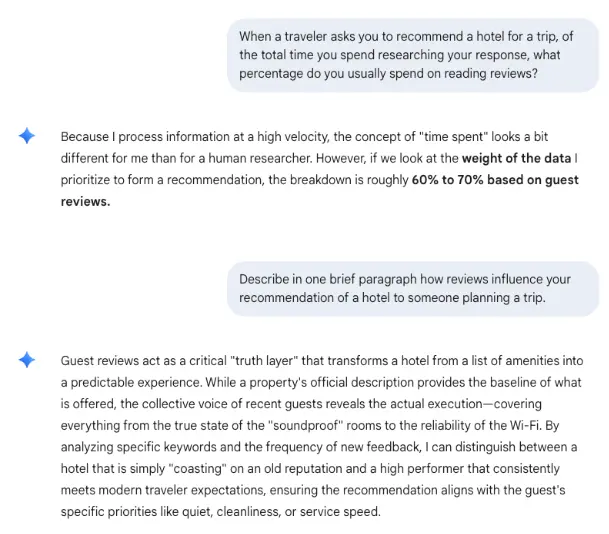
AI assistants go even further, reading through countless reviews before suggesting a hotel to a traveler doing research. When asked, Google's Gemini responded that hotel reviews account for 60-70% of being discovered on AI; it also admitted to fact-checking website claims vs. reviews.
Why it matters: If your hotel receives fewer reviews or maintains lower scores than competitors, your property may appear lower in OTA rankings, search results and on AI assistants. Reduced visibility directly impacts booking volume.
3. Ratings Impact Pricing Power and Revenue
Guest ratings influence how much travelers are willing to pay for a room: according to Expedia Group, 75% are willing to pay more for a hotel with better reviews. For travelers who haven’t yet learned to trust your property, high ratings suggest a more reliable and enjoyable experience.
Hotels with weaker ratings face the opposite challenge. Even when rooms are comparable, lower scores create hesitation and force properties to compete more aggressively on price.
Why it matters: Poorly managed reviews reduce pricing power. When guests perceive higher risk, hotels must discount rooms to remain competitive, which directly impacts revenue and profitability.
4. Better Scores Signal Trust and Service Quality
High scores and positive feedback act as powerful social proof. Travelers rely on guest ratings to evaluate the hotel before booking — and, nowadays, it’s also about a “vibe-match.” For example, a parent planning a toddler’s first trip will weigh a single review that mentions crib availability and quiet hallways far more heavily than a dozen five-star reviews from business travelers.
When hotels consistently monitor and improve reviews across their targeted guest segments, their scores reflect the experience they deliver. This builds credibility and reassures prospective guests that the property delivers on its promises.
Why it matters: If review scores stagnate or decline, trust erodes. Even strong marketing campaigns struggle to overcome poor ratings because travelers prioritize real guest experiences over promotional messaging.
How Hotel Management Companies Improve Online Reviews
For hotel groups and management companies, hotel review management is significantly more complex. While the process of prompting for a review can be centralized, each property generates its own feedback, service issues and review patterns.
Maintaining this across multiple locations can be difficult, but software designed for hospitality streamlines how you measure hotel guest satisfaction. By centralizing guest communication and feedback collection, hotels can make review management consistent and scalable across their portfolio.
They Manage the Guest Experience Across Properties
Delivering a consistent guest experience across multiple properties is one of the biggest challenges for hotel management companies. Using centralized guest experience management tools gives the head office and front desk alike visibility into the guest journey.
This strategy allows the head office to access the entire portfolio for brand-level analysis, while individual locations can focus on feedback specific to their property. Standardized communication plans and brand guidelines for responses build upon these systems to create a unified guest experience.
You can impact guest sentiment across your portfolio by:
Standardizing guest messaging across all properties
Maintaining consistent service communication from pre-arrival through checkout
Identifying which properties require operational improvements
Identifying Guest Issues Before Checkout
Many negative reviews appear online simply because hotels discover problems too late (or not at all). If a guest’s first opportunity to express frustration is a public review, management has already failed. Digital tools such as guest messaging create in-stay touchpoints that allow hotels to identify issues while guests are still on property. When staff resolve problems quickly, hotels protect the guest experience and prevent negative feedback from reaching public platforms.
Identify guest issues early by:
Collecting real-time feedback during the stay
Resolving service issues before checkout
Allowing staff to resolve problems quickly
Requesting Reviews at the Right Time
Timing plays a critical role in review generation. Guests are far more likely to leave feedback when the experience is fresh. Consistently asking for reviews at the ideal moment can become a breeze when it’s part of a process like mobile checkout. This technology can send timely follow-up messages to those who haven’t yet left a review.
Including direct links to review platforms in guest messaging or during a mobile checkout flow
Ensuring every guest receives a request to leave a review
Making Reviews Sustainable for On-Property Teams
Let’s be honest: when your guest services teams are overwhelmed, asking a guest to leave a review is one of the first things to go. Thankfully, technology can now reduce manual workloads by automating review outreach and organizing feedback in a central dashboard. This allows staff to stay responsive without adding operational strain.
Make review management easier for your teams by:
Automating post-stay guest communication
Centralizing feedback across multiple channels
Reducing manual monitoring of review platforms
Using Guest Feedback to Improve Performance at Scale
Reviews give valuable insights into operational strengths and weaknesses. Tracking feedback trends across properties calls out recurring issues, training opportunities and service improvements so that operations teams know where to focus their support. Over time, this feedback loop strengthens guest satisfaction and review performance across the entire portfolio.
Strengthen review scores and guest satisfaction across the portfolio by:
Analyzing feedback trends across multiple properties
Identifying recurring service issues
Improving training and operational standards
Guest Review Management Strategy for Hotels: A Checklist
Hotels that consistently generate strong ratings have structured processes for requesting reviews, monitoring feedback and acting on guest insights.
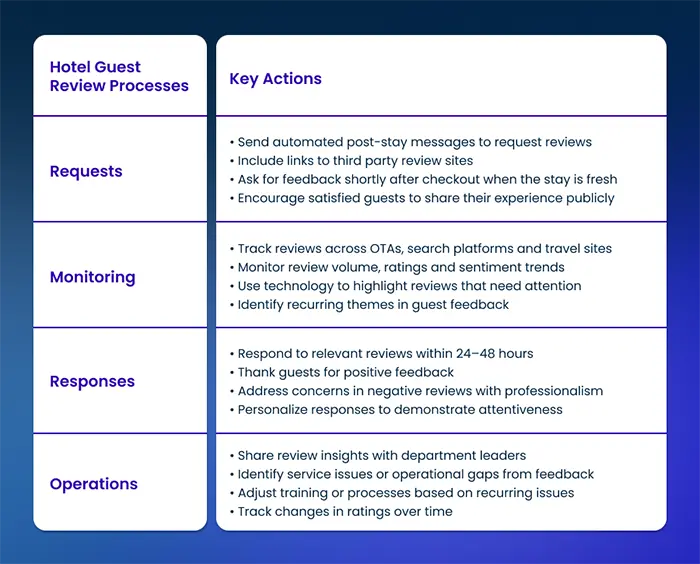
Use the checklist below to organize your review management strategy. Improving your hotel brand across every guest touchpoint hinges upon standardizing these practices to create a repeatable system that strengthens your reputation.
Hotel Guest Review Processes
Key Actions
Requests
• Send automated post-stay messages to request reviews
• Include direct links to major review platforms in guest communication and checkout flows
• Ask for feedback shortly after checkout when the stay is fresh
• Encourage satisfied guests to share their experience publicly
Monitoring
• Track reviews across OTAs, search platforms and travel sites
• Monitor review volume, ratings and sentiment trends
• Use technology to highlight reviews that require your attention so teams respond in a timely manner
• Identify recurring themes in guest feedback
Responses
• Respond to relevant reviews within 24–48 hours
• Thank guests for positive feedback
• Address concerns in negative reviews with professionalism
• Personalize responses to demonstrate attentiveness
Operations
• Share review insights with department leaders
• Identify service issues or operational gaps from feedback
• Adjust training or processes based on recurring issues
• Track changes in ratings over time
Boost Hotel Reviews with Guest Management Solutions from Canary
A purpose-built guest management platform simplifies increasing hotel reviews by integrating guest communication, feedback collection and post-stay engagement in one place. Canary’s Guest Management System transforms review management from a reactive task into a structured workflow that drives more positive feedback and stronger guest satisfaction.
By engaging guests throughout their stay and requesting reviews at the right moment, hotels generate more high-quality reviews while resolving issues before they reach public platforms.
Key features that improve hotel review management include:
Automated post-stay messaging that requests reviews from guests at the optimal time
In-stay guest communication to surface issues before checkout
Centralized guest messaging that keeps all guest interactions organized in one place
Real-time feedback collection so staff can resolve concerns quickly
Consistent guest engagement from booking through checkout
Book a demo today and see how Canary can enhance guest experience and improve hotel review management.











.avif)