Choosing between a hospitality industry mobile application and a web-based solution is a decision that touches everything: revenue, guest experience and your team’s efficiency. Native apps used to feel like the obvious modern choice. But with a seemingly endless number of apps competing for space on our phones, most travelers aren't eager to download another one for a simple two-night stay.
Thankfully, web-based tools do everything an app does — without the download. In this guide, we compare mobile apps for hotels to web solutions and show how Canary’s mobile web Guest Management Platform drives higher adoption, stronger ROI and a better guest experience from discovery to post-stay.
Key highlights:
Mobile applications for hotels are apps guests download to their phones to check in, message the front desk and browse upgrades during their stay.
Web-based tools do the same things via a browser link, creating a lower barrier to entry.
Traditional hotel apps tend to see low engagement, cost more to build and require frequent upkeep across iOS and Android.
Canary's web-based platform gives guests a smoother experience and hotels better results. This means more revenue and less manual work without asking anyone to download a thing.
What Are Mobile Applications in the Hospitality Industry?
Mobile applications in the hospitality industry are digital tools for smartphones and tablets. They support guest-facing interactions and hotel operations across the entire stay.
Before arrival, guests use apps to:
Manage reservations
Complete check-in forms
Verify identity
Authorize payments
Select rooms
During the stay, they facilitate:
Digital room keys
Service requests
Real-time messaging
Access to property information
Upsell offers such as upgrades or late checkout
After departure, they:
Streamline mobile checkout
Provide digital folios
Collect feedback
Encourage loyalty program participation
On the operational side, apps for hotel management assist with:
Housekeeping management
Maintenance tracking
Front desk workflows
Room status updates
Secure payment documentation
These tools create a connected digital experience that improves efficiency, reduces manual work and meets modern guest expectations for convenience and speed. They do this by integrating with core systems like Property Management Systems (PMSs), Point Of Sale Systems (POSs), Customer Relationship Management (CRMs) platforms and payment gateways.
Why Leading Hotels Are Moving Beyond Native Mobile Apps for Hospitality
For years, hotel mobile apps seemed like the obvious path to a more modern guest experience. Custom apps were one of the first ways that hotels digitized check-in, messaging and loyalty programs — but for many, that investment didn’t pay off.
The good news is, alternatives are now making digital actually work. Guest habits, operational realities and the headache of long-term upkeep are pushing hotels toward simpler, more accessible tools. Here's why:
Guest Download Friction Limits Adoption
Hotel guest apps require guests to download. It might seem easy, but this is where friction begins. Travelers are increasingly selective about which apps earn space on their phones. Over 90% of consumers don’t like being forced to download an app to do business, according to Forbes.
Most guests won't download an app for a short stay. And if they don't download it, they don't engage. That means no mobile check-in, fewer upsell opportunities and a front desk queue that stays just as long. Here are some reasons why guests won’t download a hospitality app:
It’s their first time at the hotel
It’s a shorter stay
They want to avoid roaming data downloads
Their phones have storage limitations
Low Engagement After Initial Install
Even when guests download a hotel app, engagement often drops quickly after arrival. App analytics across industries consistently show steep usage decline after initial install. Business of Apps reports that many apps lose most users within the first 30 days. Zippia data shows 70% of all app users worldwide stop engaging with (or uninstall) an app within three months of downloading it, and 51% of users uninstall an app if it consumes excessive memory.
In hospitality, where stays are temporary, this drop-off happens even faster. Once guests check out, many delete the app or never open it again.
High Development and Ongoing Maintenance Costs
Building a hospitality industry mobile application requires significant upfront investment and continuous updates.
Hotels must develop separate apps for iOS and Android. They have to test it across devices, update it regularly to maintain compatibility with new operating systems and hardware standards — and costs don’t stop at launch. With an app, you need:
A dedicated development team or an external agency
Ongoing security updates and compliance checks
UX redesigns to match evolving guest expectations
Integration maintenance with PMS and other systems
App Store Dependency Slows Innovation
Native apps operate within the constraints of app store ecosystems, which introduces another layer of complexity.
Every update must pass review processes from Apple or Google. Policy changes can require immediate adjustments. Delays in approvals slow down feature rollouts and bug fixes. This dependency limits agility because:
Release cycles depend on third-party review timelines
App store policies can shift without warning
Visibility in crowded app marketplaces remains challenging
Guests must manually update to access new features
Operational Complexity for Hotel Teams
Hotel mobile applications don't always make operations simpler. Sometimes they add work. Staff end up juggling app messages alongside every other communication channel. Front desk teams find themselves walking guests through downloads during busy check-in windows. And IT gets pulled into troubleshooting device and compatibility issues.
Benefits of Web Apps for Hotel Management
Hotels are being asked to do more (provide faster service, increase profit margins) with less (leaner operations, staff shortages) all without making things harder for guests or staff. Hotel operations software helps on all of those fronts by getting the admin tasks out of the way and running everything more smoothly. It's designed to be easy to access and grow with you from the start.
Here's what that looks like in practice:
Guests can get started immediately: No app download needed. Guests simply tap a link to check in, message the front desk, pay and browse upgrades. Fewer steps means more guests actually use it.
More engagement across the board: When there's no download barrier, a higher share of guests complete pre-arrival forms, buy upgrades and use digital tools throughout their stay (even if they’re not the most tech-savvy travelers).
Faster to launch and easy to update: New features and fixes go live instantly across all your properties, without waiting on app store approvals.
Lower ongoing costs: One system to build and maintain means less money spent on development, fewer technical headaches and more predictable costs over time.
Easier for staff to learn and use: Browser-based tools work the way your team already expects, cutting down on training time and day-to-day tech frustrations so staff can focus on guests.
Web vs Mobile App Solutions: Key Differences
Choosing between a native mobile app and a web-based solution affects how many guests actually engage, how smoothly your team operates and what you'll be spending on tech for years down the line.
The side-by-side comparison below highlights how each approach performs in real-world hotel environments.
Area
Native Mobile Apps for Hotels
Web-Based Hospitality Apps
Guest Access
Requires guests to download from an app store before use, adding friction and creating a barrier for short-stay guests or first-time visitors.
Accessible instantly through a secure browser link via SMS or email, removing download requirements and reducing guest effort.
Adoption Rates
Often limited by download hesitation and storage concerns, leading to lower participation in mobile check-in, messaging and upsell offers.
Higher engagement as every guest can participate immediately, which increases digital interaction across pre-arrival, in-stay and checkout workflows.
Maintenance
Requires separate iOS and Android development, ongoing updates and compliance with app store policies and operating system changes.
Operates on a single codebase with real-time updates deployed automatically, ensuring guests and staff always access the latest version.
Time to Value
Longer rollout timelines due to development cycles, testing and app store approvals.
Faster implementation and immediate activation across properties, accelerating ROI and delivering measurable impact quickly.
Operational Overhead
Adds complexity through app troubleshooting, staff training and fragmented communication channels tied to download-based engagement.
Streamlines operations with browser-based workflows that reduce technical support needs and simplify staff onboarding.
How Web-Based Hospitality Apps Improve Adoption and Engagement
The best platform in the world only works if guests actually use it. And most won't bother downloading an app just to check in or message the front desk.
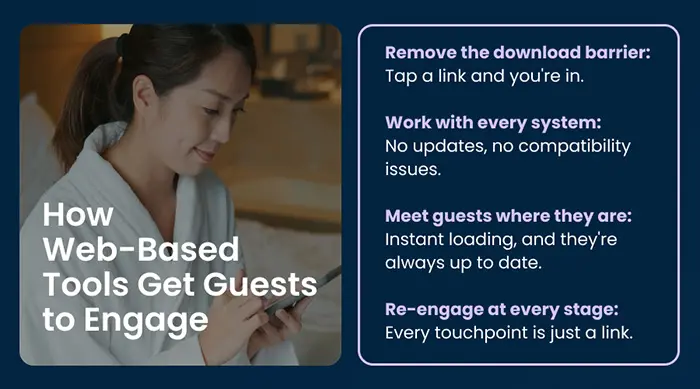
Web-based tools win on adoption because there's nothing to install. Guests just tap a link and they're in. That simplicity translates to more engagement at every stage of the stay, from before arrival to after checkout.
No-Download Access Removes Barriers
The biggest obstacle to mobile engagement is the need to download. Guests hesitate to install an app for a short stay, especially if they’re visiting your property for the first time.
Web-based hospitality apps eliminate that decision entirely. Guests simply tap a secure link delivered via SMS or email and instantly access services in their browser. Using a web-based hospitality app means:
No app store searches
No password creation or account setup delays
No storage concerns
No waiting for downloads on slow connections
Works Across Any Device or Operating System
Web-based tools work on any device (iPhone, Android, tablet, laptop) because they run in a browser rather than being built separately for each operating system. That means no fragmentation, no waiting on OS updates and no extra steps for international guests who may be on unfamiliar devices or app stores.
This universal accessibility means every guest can engage digitally without technical barriers.
Communication Happens Where Guests Already Are
Guests are already texting and emailing. Web-based tools simply plug into those habits. A text prompts them to check in and an email link lets them check out with no separate app to open or system to learn. Because it fits into how they already communicate, more guests respond and the whole interaction feels natural.
Web-based apps use:
Pre-arrival links delivered via SMS
In-stay messaging without app logins
Payment authorization through secure web forms
Post-stay follow-ups sent directly to inboxes
Faster Load Times Improve Guest Experience
Speed matters. If something loads slowly or crashes, guests give up. Web-based tools open instantly in the browser and stay up-to-date automatically, which means no app updates or manual refreshes. That snappier experience means guests are more likely to follow through, whether it’s to buy an upgrade or put in a service request.
Easier Re-Engagement Throughout the Guest Journey
Check-in is just the beginning of the guest relationship, and web-based tools make it easy to stay connected. Because every touchpoint is just a link, you can reach guests before they arrive, during their stay and after they leave without worrying about whether they still have an app installed. That means timely check-in reminders, mid-stay upsell offers, departure day checkout prompts and post-stay feedback requests all happen naturally, with no extra friction for the guest.
Key Functionality Hotels Expect From Modern Hotel Guest Apps
Hotels aren't adopting digital tools for the sake of it. They want real results: smoother operations, more revenue and happier guests. Whatever platform you choose, it should make the stay easier for guests and take work off your staff's plates.
Here are the core capabilities hotels prioritize today:
Mobile Check-In and Checkout: Guests complete registration, verify identity, authorize payments and check out from their own devices, reducing front desk congestion, shortening wait times and accelerating room readiness and departure workflows.
Digital Hotel Compendium: Guests access property information, amenities, dining menus, local recommendations and service details in real time, reducing repetitive front desk inquiries while improving on-property discovery and satisfaction.
Guest Messaging: Two-way, real-time communication centralizes service requests, questions and updates in a single digital thread, increasing response speed, improving accountability and strengthening the overall guest experience.
Dynamic Upsells: Personalized upgrade and add-on offers presented before and during the stay drive incremental revenue, increase ancillary spend and maximize the value of each reservation without additional staff effort.
Secure Payments and Authorizations: Encrypted payment processing, digital card authorizations and automated documentation reduce fraud risk, minimize chargebacks and eliminate paper-based processes that slow operations and increase errors.
How to Choose the Best Solutions for Hotel Tech Integrations
Choosing a mobile strategy is a long-term commitment, not just a software purchase. The right platform needs to work with your existing systems, grow with your portfolio and deliver real results. But rather than just comparing feature lists, focus on how each option actually performs in a hotel environment.
Here's what to look for:
Compatibility With Existing PMS and Core Systems
Your guest platform has to talk to your other systems (PMS, payment processors, CRM) without constant manual work in between. When everything connects properly, data moves automatically, errors drop and every department works from the same guest information.
Automatic updates for room status and guest folios
Little to no manual reconciliation needed
Ease of Deployment and Ongoing Management
The faster you're up and running, the sooner you see results. A lengthy rollout ties up resources and delays ROI. The best platforms go live quickly, require minimal IT involvement and update automatically without disrupting day-to-day operations.
Ask about:
How long deployment takes for one property or many
What ongoing maintenance actually looks like
Whether you'll need dedicated in-house technical support
How easy it is to monitor performance across properties
Guest Adoption and Ease of Use
The fanciest platform is useless if guests don't engage with it. Think about how your actual guests will interact with the solution. Is it easy to access? Does it create extra steps?
Prioritize:
Functionality on any smart device
Check-in and checkout that take as few steps as possible
Clear, familiar ways to communicate
A consistent experience for all guests, regardless of how tech-savvy they are
Flexibility Across the Guest Journey
The right platform should support the full hotel guest journey (not just check-in!). Look for something flexible enough to grow with you, so you can add new workflows and revenue opportunities without rebuilding from scratch.
Make sure the system handles:
Pre-arrival registration and upsell offers
Messaging and service requests during the stay
Mobile checkout and digital receipts
Post-stay feedback and loyalty follow-up
Security, Compliance and Data Protection
Handling guest payments and personal information requires rigorous security standards. A platform must protect both your guests and your brand reputation. Strong security infrastructure reduces fraud, chargebacks and compliance risk while building trust with travelers who increasingly expect secure digital experiences.
Regular security updates and vulnerability monitoring
Simplify Guest Experiences with a Web-Based Application for Hotel Management from Canary
Guests expect instant access. Staff need fewer manual tasks. Revenue teams demand measurable performance. Canary delivers all three through a modern, web-based platform designed specifically for the hospitality industry.
Canary’s browser-based solution meets guests where they are — on their phones. From post-booking to checkout, every interaction flows through a single, easy digital experience that drives adoption, increases revenue and reduces operational friction. As a leading guest management system, Canary helps hotels modernize how they manage the guest experience without making things complicated.
Solutions Offered by Canary
Mobile Check-In and Smart Checkout: Reduce front desk lines, accelerate arrivals and departures and improve guest satisfaction with seamless integrations.
Dynamic Upsells: Drive measurable ancillary revenue with personalized upgrade and add-on offers delivered before and during the stay.
Guest Messaging: Centralize communication in one real-time dashboard to improve response times and streamline service coordination.
Digital Authorizations: Eliminate paper forms, reduce fraud and minimize chargebacks with secure, PCI-compliant payment workflows.
Digital Compendium: Replace printed materials with an interactive, revenue-generating digital guide accessible instantly from any device.
Canary AI: Automate routine guest interactions while freeing staff to focus on high-value service moments.
Trusted by more than 20,000 hoteliers across 80 countries — including leading global brands — Canary delivers higher adoption rates, stronger operational efficiency and measurable revenue growth without requiring guests to download an app.
Book a demo today and see why Canary is the best web-based solution for hotel guest management.
Frequently Asked Questions
Why might a business prefer a web application over a mobile app?
Web-based tools remove the biggest barrier to engagement: the download. Guests can tap a link and get started immediately, which means more of them actually do. They're also easier to update, don't depend on app store approvals and cost less to maintain, especially across multiple properties.
Are mobile apps enhancing or diminishing brand loyalty in the hospitality industry?
It depends on how often guests stay with you. Frequent travelers who use a brand's app regularly can build a stronger connection. But for one-time or occasional guests, a required download often means they simply don't engage. Loyalty comes from experiences that feel easy and seamless, not from whether it's an app or a browser.
What is one reason why web applications are more cost-effective than mobile apps?
With a web app, you build and maintain a single version that works across all devices. Hospitality industry mobile applications require separate builds for iOS and Android, which means more development time, more testing and more ongoing upkeep.
Can I still offer key functionality like mobile check-in and digital compendiums without an app?
Yes. Web-based platforms support all the core features like check-in, room registration, payment, messaging and digital compendiums directly in a browser. Guests receive a secure link by text or email and access everything without downloading anything.
How can I send real-time offers or alerts to guests without push notifications?
SMS and email work just as well, often better. Automated messages can promote upgrades, send reminders or share updates instantly. Since guests are already checking their texts and inbox throughout the day, response rates tend to be strong — no app required!